TOURISTS INFORMATION
Entry Regulations | Time Zone | Getting There | Health Regulations | Airport Information |
Climate | What to Wear | Currency | Tipping | Local Transport | Language | Accommodation
Dining Out | Entertainment and Culture | Shopping | Business and Banking Hours |
Credit Cards | Electricity | Water | Communications Facilities | Convention Facilities |
Medical Facilities | Tours and Special Interest Activities | Public Holidays |
Important Contact for Tourists |
Entry Regulations
Foreign nationals who are traveling to the Philippines for business and tourism purposes are allowed to enter the Philippines without visas for a stay not exceeding 21 days, provided they hold valid tickets for their return journey to port or next port of destination and their passports valid for a period of at least six (6) months beyond the contemplated period of stay. However, Immigration Officer at port of entry may exercise their discretion to admit holders of passports valid for at least sixty (60) days beyond the intended period of stay.
Time Zone
One time zone. 120° East Meridian Time or GMT + 8 hours.
Getting There
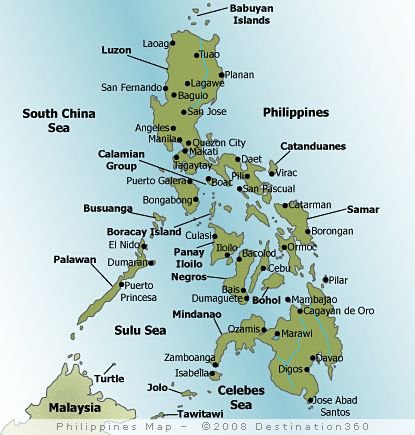
Manila, Cebu, Davao,
Clark, Subic, and Laoag are the international
gateways. The Ninoy Aquino International Airport (NAIA) in Manila is the premier gateway. It is served
by more than 30 airlines which fly to different cities around the world. The
Mactan International Airport (MIA) in Cebu handles regular flights from Japan, Singapore
and Australia as well as
chartered flights from Hong Kong, the United States and other major
travel capitals. Davao International Airport
handles regular flights from Indonesia
and Singapore.
The Diosdado Macapagal
International Airport
and Subic airfield in Central Luzon service
both chartered and cargo planes. Laoag
International Airport
in Ilocos Norte services regular flights from Taiwan
and Macau.
Philippine Airlines, the country's flag carrier, links Manila to 14 cities in 8 countries. Major
cruise liners call on the port
of Manila.
<back to top>
Health Regulations
A certificate of vaccination against yellow fever is required for travelers
coming from infected areas.
Airport Information
Airport and Facilities: Manila's Ninoy Aquino
International Airport (NAIA) is 7 km. from the city center, while the Manila Domestic
Airport is one kilometer
from the NAIA. The international airports have adequate traveler facilities:
duty-free and souvenir shops, tourist information and assistance counters,
hotel and travel agency representatives, car rental services, banks and
automated teller machines, postal service, national and international direct
dial telephone booths, medical clinics, and baggage deposit areas.
Facilities for the Physically-Handicapped: The airports are
handicapped-friendly. Wheelchairs are available on request from the airline
ground staff.
Customs: Visitors are advised to fill in the Baggage Declaration Form
before disembarking to facilitate Customs examination. The following are
allowed duty-free: reasonable quantity of clothes, jewelry, and toiletries; 400
sticks of cigarettes or two tins of tobacco; two bottles of wine or spirits of
not more than one liter each. Porterage: Baggage carts are available for free.
Porter services are also free. Tipping is traditional.
Airport Transfers: Visitors are advised to avail of accredited fixed
rate or metered taxis at the NAIA's Arrival Area. At the Manila Domestic
Airport, accredited
transfer services are available on pre-paid coupon basis. Other airports are
served by metered taxis. All airports have counters for hotel transport and car
rental service. Airport Fees: P550 for international departure and P100 for
local departure (paid in Philippine pesos only). Departing passengers for
international destinations are advised to check with airport or tourist
information counters (Tel. Nos 524-1703; 832-2964) The departure fees may
change without further notice.
Duty-Free Shopping: Duty-Free Philippines near the NAIA is the
country's largest duty-free outlet carrying quality imported items and selected
Philippine export products.
<back to top>
Climate
March to May is hot and dry. June to October is rainy. November to February is
cool. Average temperatures: 78°F/25°C to 90°F/32°C; humidity: 77%.
What to Wear
Light, casual clothes are recommended. Warmer garments are needed for mountain
regions. When visiting churches and temples, propriety dictates that shorts and
scanty clothing be avoided. Formal occasions require dinner jackets and ties
(or the Philippine barong tagalog) for men and cocktail dresses or long gowns
for women.
Currency
Unit of currency: Peso (P) = 100 centavos. Bank notes: P10, P20, P50, P100,
P200, P500 and P1,000. Coins: 5c, 10c, 25c, P1, P5, P10.
Tipping
Tipping is expected for many services. The standard practice is 10% of the
total bill. Tipping is optional on bills that already include a 10% service
charge.
<back to top>
Local Transport
By air, Philippine Airlines (Tel. No. 855-9999), Air Philippines (855-9000), Cebu
Pacific (636-4938) provided daily services to major cities and towns. Asian
Spirit (851-8888), Laoag International Airlines (551-9729), and Seair
(891-8708) service the missionary routes. There are also scheduled chartered
flights to major domestic destinations serviced by smaller commuter planes.
By sea, inter island ships connect Manila
to major ports. Ferry services connect the smaller islands.
By land, Philtranco connects Manila to Bicol
in Southern Luzon, to Samar and Leyte in the Visayas, and Davao
in Mindanao.
Metered and fixed rate taxis are widely available in key cities nationwide.
Jeepneys and buses are inexpensive ways of getting around most places. In Metro
Manila, the fastest way of commuting is via the railway system. LRT connects
the northern district of Monumento to the southern district of Baclaran with
stations situated at major intersections. MRT traverses the length of EDSA and
connects North Avenue
in Quezon City to Taft Avenue in Pasay
City, passing through the major
arteries of Makati's
financial district.
Language
Filipino is the national language. English is the business language and spoken
widely.
Accommodations
In Metro Manila, key cities and towns throughout the country, a wide selection
of de luxe, standard, economy, and pension-type accommodations are available.
In island destinations, there is a variety of resorts ranging from de luxe to
special interest category.
<back to top>
Dining Out
Filipino food is an exotic, tasteful blend of Oriental, European, and American
culinary influences. There is a wide variety of fresh seafood and delectable
fruits. First class restaurants offer gourmet specialties as well as Filipino
cuisine.
Entertainment and Culture
Metro Manila is
the center of entertainment and cultural activities. The premier venue for the
performing arts, the Cultural
Center of the Philippines, features world-class performances by local and
international guest artists. Museums located in Manila and in some parts of the country offer
a glimpse of Philippine history and culture. Art galleries exhibit the works of
the country's leading and promising visual artists.
Manila's nightlife is one of the most vibrant
in Asia, reflecting the Filipino's love for
music. The hubs of nightlife activities are the Remedios Circle in Malate, Ayala Center
and The Fort at Bonifacio Global City
in Makati, Timog and Tomas Morato Avenues in Quezon City, and Eastwood in Libis, Quezon City. Nightclubs, music lounges, pubs,
and sing-along bars feature Filipino bands and singers who are known for their
great musical talent. De luxe hotels offer a variety of live musical
entertainment. Concerts and stage plays form part of the country's entertainment
scene.
For visitors who want to try their luck at the gaming tables there are
casinos in Metro Manila and in the cities of Angeles, Olongapo, Tagaytay, Cebu,
Davao, Bacolod, and Laoag.
Shopping
Visitors can choose from an exciting selection of great buys in a country known
for export-quality items at reasonable prices: South Sea
pearls, handwoven cloths, embroidered fineries, fashionable ready-to-wear and
haute couture clothes, terra-cota, porcelain, and mother-of-pearl home
accessories. Artifacts, pineapple fiber shirts, prehistoric jars, native
handicrafts, and footwear are interesting items, too. The Philippines
also produces fine basketry, furniture, fresh and processed fruits, exquisitely
crafted jewelry, and gift items made of wood and stone.
Big malls are located in Manila, Makati and EDSA, while handicraft, antique and curio shops
abound at the Ermita District in Manila.
<back to top>
Business and Banking Hours
Private and government offices are open either from 8:00 a.m. to 5:00 p.m. or
from 9:00 a.m. to 6:00 p.m. Some private companies hold office on Saturdays
from 9:00 a.m. to 12:00 noon. Most shopping malls, department stores, and
supermarkets are open from 10:00 a.m. to 8:00 p.m. daily. There are also
24-hour convenience stores and drugstores nationwide.
Banks are open from 9:00 a.m. to 3:00 p.m., Mondays to Fridays, with
automated teller machines (ATM) operating 24 hours.
Credit Cards
International credit cards such as Visa, Diners Club, Mastercard, and American Express
Card are accepted in major establishments.
Electricity
220 volts, A.C. 60 cycles. Most hotels have 110-volt outlets.
Water
Water in Metro Manila and in key cities and towns is potable and safe for
drinking. Bottled water is available in many hotels, restaurants, resorts,
supermarkets, and convenience stores.
<back to top>
Communications Facilities
The country has international and national direct dial phone and facsimile
services, mobile phone sites, internet and e-mail facilities, and worldwide
express delivery service. The postal system is efficient.
Most national dailies are in English. Foreign publications are sold at major
hotels, malls, and bookstores in Metro Manila and key cities. There are 7
national television stations which broadcast mainly in Filipino. Cable TV is
available in many hotels in Manila
and in many parts of the country.
Convention Facilities
Manila, the pioneer convention city in Asia, has played host to a number of prestigious
international events. The Philippine International Convention Center is
equipped with modern convention facilities and services. It can accommodate
4,000 delegates in its Plenary Hall and 5,700 persons in its Reception Hall.
The World Trade Center
near the PICC can hold huge exhibitions and events. Smaller meetings can be
held in hotels and other establishments. Out-of-town hotels and resorts are
alternative convention sites.
<back to top>
Medical Facilities
Hospitals in the
country are equipped with modern facilities to meet any medical need. In some
remote towns and cities, clinics and health centers provide emergency medical
attention. Most hotels and resorts provide medical assistance. Hospitals are
listed in the "Yellow Pages" of the local telephone directory.
Tours and Special Interest Activities
Tour packages (WOW Package and Other Packages) from
day trips to five-day programs, are special ways of discovering the Philippines and
its wealth of culture. Special interest activities include golfing,
game-fishing, diving, white-water rafting and other aqua sports, trekking,
spelunking, and safari trips.
Tour details and other requirements may be obtained from the Philippine Convention and Visitors Corporation, 4F,
Legaspi Towers 300, Roxas Boulevard, Metro Manila, Philippines 1004,
Tel. Nos. (+632) 525-1255 / 5259318 loc. 244, 268 & 250
Fax No. (+632) 521-6165 / 525-3314
Public Holidays
New Year's Day, January 1; Edsa Revolution Day, February 24; Araw ng
Kagitingan, April 9; Maundy Thursday and Good Friday, moveable; Labor Day, May
1; Independence Day, June 12; National Heroes Day, last Sunday of August; All
Saints' Day, November 1; Bonifacio Day, November 30; Christmas Day, December
25; Rizal Day, December 30.
<back to top>
Important Contact for Tourists
Department of Tourism Information Center: (+632) 524-1703
24-hour Tourist Assistance: (+632) 524-1782/ 524-1660
Bureau of Immigration: (+632) 527-3280
|